
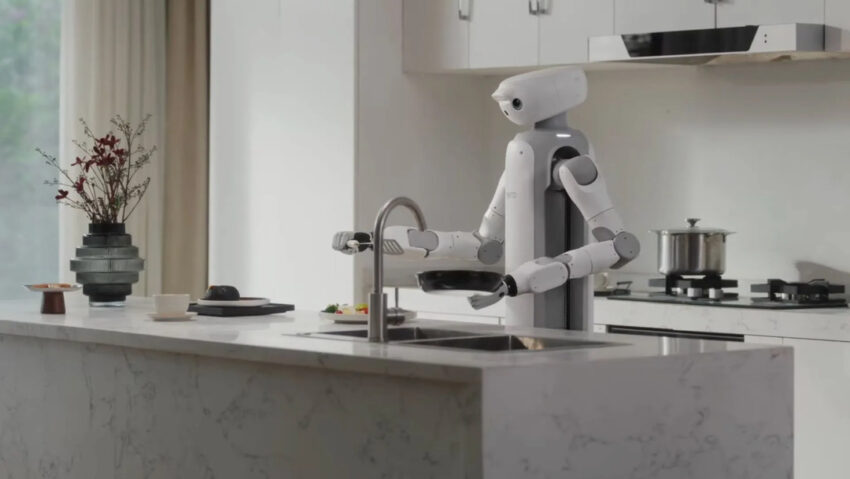
The SwitchBot Onero H1 is one of the more intriguing home robots announced in 2026, largely because it aims to do something most consumer robots still struggle with: interact with the physical world beyond floors and flat surfaces. Instead of stopping at vacuuming and mopping, the Onero H1 is positioned as a universal humanoid household robot designed for chores such as handling laundry, opening appliances, organizing items, and assisting with contact-heavy tasks around the home. SwitchBot says the robot uses its Omni Sense VLA system, which combines vision, depth, touch, and language to carry out these jobs more reliably.
That pitch alone is enough to make the Onero H1 stand out. The bigger question is whether it is a practical product buyers should seriously consider right now, or whether it is still more of a forward-looking concept with a retail button attached.
What the SwitchBot Onero H1 Actually Is
At its core, the Onero H1 is a wheeled humanoid-style home robot. It does not walk on legs. Instead, it moves on a rolling base and uses articulated upper-body components to perform tasks that require reach, grip, and object handling. According to SwitchBot’s product page, it is the company’s first universal humanoid household robot, and it is intended to work in tandem with other smart home devices and robots. SwitchBot even frames the division of labor clearly: its vacuum robot handles the floor, while the H1 handles chores “above.”
Coverage from CES 2026 adds useful real-world context. Engadget reported seeing the Onero H1 pick up clothing from a couch, move to a washing machine, open the door, place the laundry inside, and close it again. That is the kind of task chain many home robotics companies promise, but few have demonstrated in a plausible domestic scenario. The robot was reportedly slow in that demo, yet the broader implication was still significant: this is a machine trying to perform multi-step home tasks, not just navigation and monitoring.

Why the Onero H1 Feels Different From Most Home Robots
The home robotics market has been flooded with products that do one thing well enough: vacuum, mop, patrol, record video, or deliver reminders. The Onero H1 is more ambitious. SwitchBot says it is built for grasping, pushing, opening, and organizing, which places it closer to the emerging category of embodied AI systems than to conventional smart appliances. MacRumors noted that the robot combines visual perception, depth awareness, and tactile feedback to understand the position and interaction state of objects, which is essential for contact-intensive chores.
That matters because a robot that can merely identify an object is not very useful in the kitchen or laundry room. A robot that can tell whether a washing machine door is open, whether a shirt is properly grasped, and how much force is needed to place it inside is operating at a very different level.
There is also a broader strategic angle here. SwitchBot already has a reputation in smart home hardware, particularly with retrofit devices and robot vacuums. The Onero H1 appears designed to fit into that ecosystem rather than exist as a standalone science project. Heise reported that it works with existing SwitchBot devices, which could make it more compelling for households already invested in the brand’s platform.
Design, Hardware, and Household Use Cases
The robot’s form factor is worth noting because it reveals a lot about its priorities. Instead of trying to replicate full human mobility, SwitchBot has gone with a practical rolling base. That is likely a tradeoff aimed at stability, cost control, and indoor usability. Heise reported that the Onero H1 has 22 degrees of freedom, giving it meaningful manipulation capability without the full mechanical complexity of a bipedal robot.
In practical terms, the Onero H1’s early promise seems strongest in the following areas:
- Laundry loading and handling
- Opening and closing certain household appliances
- Picking up and organizing objects
- General assistance in smart home workflows
Those use cases sound impressive, but they also reveal the product’s biggest challenge: reliability. Household environments are messy, inconsistent, and full of edge cases. A trade show demo is encouraging, but it is not the same as daily use in an ordinary home.
SwitchBot Onero H1 Price and Where to Buy
Here is where the review becomes more cautious. As of April 15, 2026, SwitchBot has the Onero H1 listed on its official product page as a preorder / coming soon item, but the page does not show a final public sale price. Independent coverage from Engadget and Heise says the robot is expected to cost under $10,000, with broader availability targeted for later in 2026.
Current buying options
| Seller | Availability status | Listed price | Notes |
|---|---|---|---|
| SwitchBot Onero H1 official product page | Preorder / Coming Soon | No final price shown | Main official listing for H1 |
| SwitchBot official store | Brand storefront | H1 not clearly listed with live checkout yet | Useful for monitoring launch availability |
At the moment, that means the Onero H1 is not yet a widely purchasable retail robot in the traditional sense. I did not find a confirmed live Amazon or Best Buy listing for the Onero H1 itself in the sources reviewed, although SwitchBot does maintain an Amazon storefront for other products.
Performance Expectations and Real-World Concerns
The Onero H1 earns credit for ambition, but buyers should temper expectations. Engadget’s hands-on report described the demo unit as somewhat slow, taking close to two minutes to move a single clothing item into a washer during the CES demonstration. That may not matter if the robot works unattended, but it does suggest the H1 is prioritizing task completion and safety over speed.
Another issue is the lack of detailed consumer-ready specifications. SwitchBot’s official page emphasizes the AI stack and vision but does not yet spell out several details shoppers usually expect before buying a premium robot: battery life, charging time, payload limits, supported appliance compatibility, warranty specifics, or maintenance requirements.
That leaves the Onero H1 in an unusual position. It is more concrete than a concept robot, yet still too lightly specified to feel fully retail-ready.
Pros and Cons at a Glance
Pros
- Genuinely ambitious household task automation beyond floor cleaning
- Uses multimodal sensing for more advanced physical interaction
- Designed to integrate with the broader SwitchBot ecosystem
Cons
- Final retail price has not been officially posted on the main product page
- Availability is still limited to preorder / coming soon status
- Public demos suggest it may be slow for some tasks
- Key technical and ownership details remain unclear
Final Verdict: Is the SwitchBot Onero H1 Worth It?
The SwitchBot Onero H1 is one of the most compelling home robots announced this year because it is aiming at real chores instead of novelty interactions. The combination of articulated manipulation, multimodal sensing, and smart home integration gives it stronger practical potential than many consumer robots that have come before it.
Still, this is not yet an easy product to recommend as a buy-right-now purchase. The biggest reasons are simple: the price is only loosely framed as under $10,000, the release window is still developing, and core consumer specs remain thin.
For early adopters, robotics enthusiasts, and smart home power users, the Onero H1 is absolutely worth watching. For everyone else, it is better viewed as a promising first-generation platform than as a fully validated household essential.
Final Score
RAVE-TECH FINAL SCORE: 7.8/10
It scores highly for innovation, ecosystem potential, and real-world ambition, but loses points for limited availability, incomplete pricing clarity, and unanswered questions around day-to-day ownership.
If you want, I can turn this into a publish-ready blog post with a stronger editorial tone, or rewrite it for affiliate SEO format with a sharper buying guide angle.