

In a headphone market crowded with premium models pushing well past the $300 mark, the Anker Soundcore Space One remains relevant for one simple reason: it keeps trying to deliver flagship-style features at a price that most people can actually justify. That matters right now, when buyers are increasingly less interested in prestige branding and far more interested in whether a product solves everyday listening problems without draining the budget.
I came to the Space One with that exact question in mind. In 2026, is this still a smart buy, or has it been overtaken by newer budget noise-cancelling headphones? After looking closely at its design, features, pricing, and overall user proposition, I think the answer is more nuanced than a quick yes or no.
Design And Everyday Comfort
The first thing that stands out about the Space One is how deliberately it is positioned for long listening sessions. Soundcore gives it 8-degree rotating ear cups, a soft integrated headband, and a foldable design meant to make storage and travel easier. At 265 grams, it is not featherlight, but it is light enough to avoid the clamping fatigue that often makes lower-cost over-ear headphones feel cheap after an hour or two.
That comfort-first approach matters because this is clearly a commuter and workday headphone, not just a casual music accessory. The fit appears tuned for extended wear rather than dramatic style. It is restrained, practical, and portable in the way many buyers actually need. I would not call the Space One luxurious, but I would call it sensible, and that is part of its appeal.
Noise Cancelling Is The Headline Feature
Soundcore makes noise cancellation the central selling point here, and not without reason. The company says the Space One uses adaptive ANC designed to reduce noise by up to 98 percent in lab conditions, while also delivering stronger voice reduction than the older Life Q30. On paper, that gives it a more serious travel and office-use profile than many low-cost rivals that treat ANC as a box-checking feature rather than a meaningful one.
In practical terms, I see the Space One as a headphone built to tame the repetitive, annoying frequencies of modern life: HVAC hum, train rumble, office chatter, and airplane cabin noise. It is also notable that Soundcore includes five levels of adjustable transparency, which is an important counterbalance. Budget ANC headphones often over-focus on isolation and underdeliver when you need awareness. Here, the attempt to make ambient control more flexible gives the Space One a more mature feature set.
The key insight is this: the Space One is not trying to beat the very best noise-cancelling headphones on the market, but it is trying to make ANC feel normal and accessible at a far lower price tier. That remains a worthwhile proposition.
Sound Quality Prioritizes Energy Over Audiophile Precision
The Space One uses 40mm dynamic drivers and supports LDAC for Hi-Res Wireless playback, which immediately places it above entry-level Bluetooth headphones that still rely on more basic codec support. There is also HearID customization and app-based EQ control, giving listeners more room to tailor the sound signature to personal taste. Multipoint connectivity is included too, making it easier to switch between phone and laptop during a normal day.
That specification sheet tells me exactly what kind of headphone this is. It is designed for modern convenience first, but with enough codec and tuning flexibility to satisfy listeners who want more than generic consumer sound. I would not expect studio-level neutrality from a product in this category. What I would expect is a lively, adaptable presentation that works across commuting playlists, podcasts, calls, and casual streaming, and the Space One appears built for precisely that mix.
This is why the headphone makes sense for mainstream buyers. It does not demand an audiophile mindset. It gives ordinary listeners just enough control to improve their experience without making the product feel technical or intimidating.
Battery Life Is A Genuine Strength
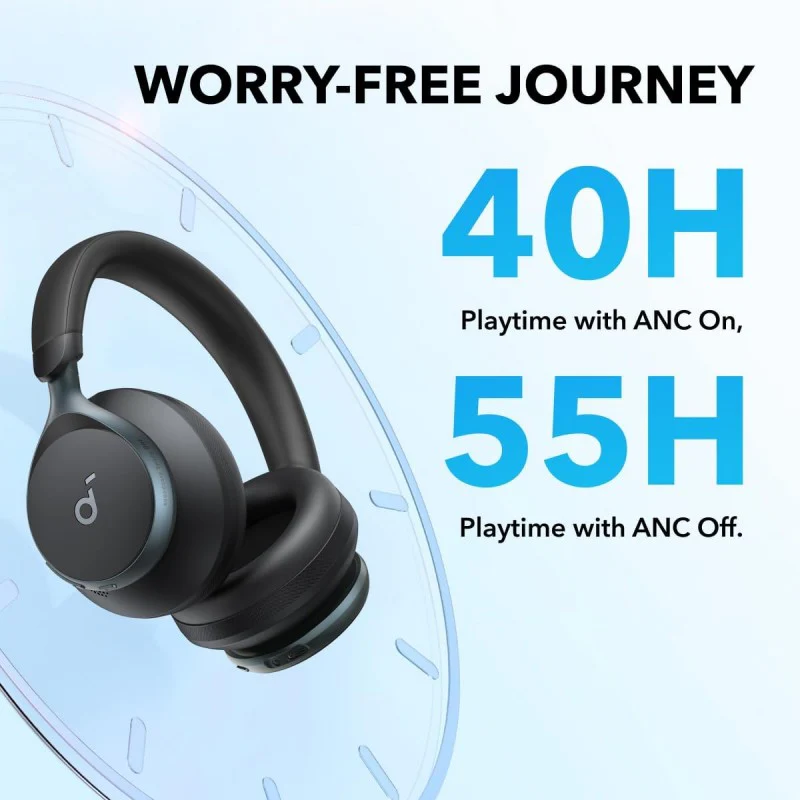
Battery endurance is one of the clearest wins here. Soundcore rates the Space One for up to 40 hours with ANC on and up to 55 hours with ANC off, with fast charging that delivers about four hours of playback from a five-minute charge. The official user guide also lists a roughly two-hour charging time for a full recharge.
Those figures matter because they move the Space One out of the “remember to charge constantly” category. For travel, office use, and weekly commuting, that kind of battery life reduces friction in a way buyers notice quickly. A headphone does not feel affordable if it becomes inconvenient, and the Space One largely avoids that trap.
Price And Value In 2026
Pricing is where the Space One becomes especially interesting. Soundcore lists it at $99.99 on its official site, while Amazon currently shows it at $69.99 for at least one color configuration, and Best Buy lists it at $99.99. That spread is important because it shifts the product from “reasonably priced” to “aggressively competitive” when discounts are active.
At $99.99, the Space One is a solid value. At around $69.99, it starts looking like one of the smarter budget ANC buys still on the market, particularly for shoppers who want over-ear comfort, app support, LDAC, adaptive ANC, and multipoint connection in one package. That is a feature stack many brands still reserve for more expensive models. For broader context on the category, the noise-cancelling headphones market continues to reward products that balance comfort, battery life, and real-world isolation rather than chasing spec-sheet vanity.
Where To Buy The Anker Soundcore Space One
You can currently buy the Space One from these major retailers:
| Retailer | Current Listed Price |
|---|---|
| Soundcore Official Store | $99.99 |
| Amazon | $69.99 |
| Best Buy | $99.99 |
Prices can vary by color and promotion, so the best deal may shift.
Final Verdict
The Anker Soundcore Space One succeeds because it understands what many buyers actually want from wireless headphones in 2026: comfort, meaningful noise cancellation, strong battery life, flexible connectivity, and a price that does not feel punishing. It is not a category-defining luxury model, and it does not need to be. Its job is to make premium-adjacent features available to ordinary listeners, and it does that convincingly.
My final score for the Space One is 8.4/10. At full retail, it is a good buy. On discount, it becomes an especially compelling one. That matters right now because value is no longer a secondary consideration in consumer tech; for many buyers, it is the whole story.
RAVE-TECH FINAL SCORE: 8.4/10