

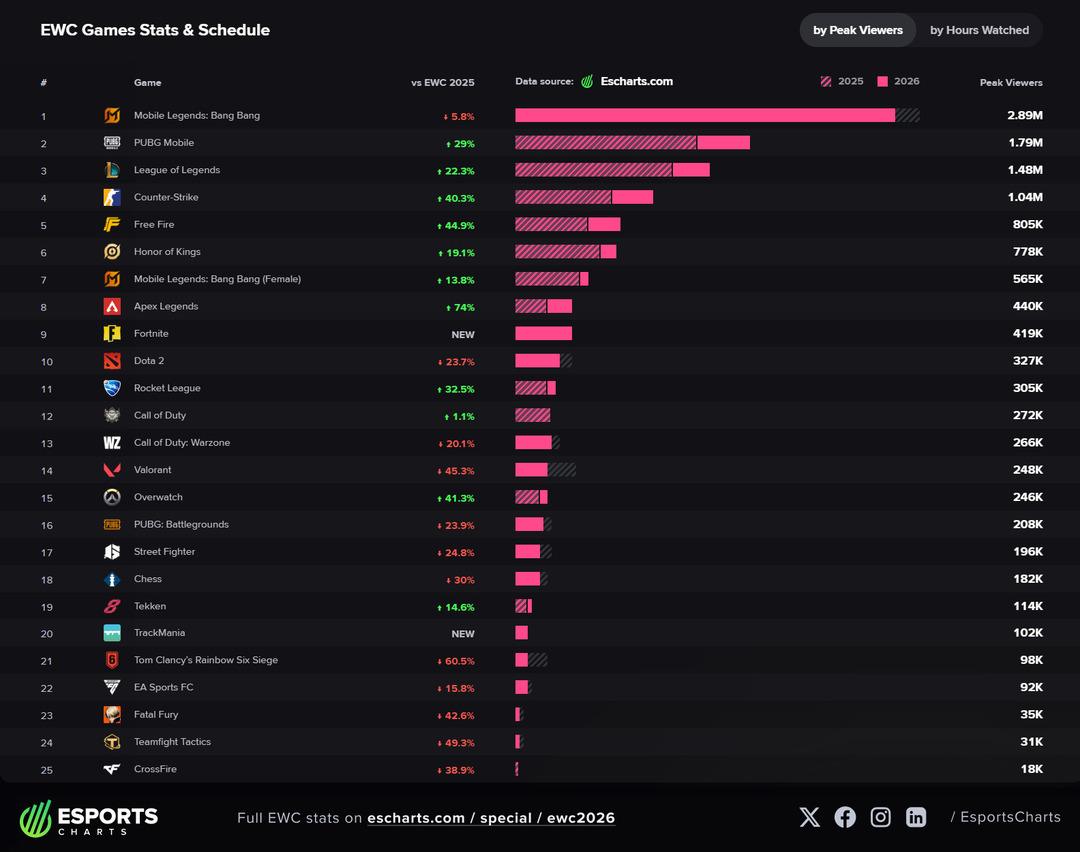
TrackMania esports viewership has just produced a number the competitive racing scene has never seen before. Its Esports World Cup debut generated roughly 923,600 hours watched while averaging about 29,300 viewers, both record marks for competitive TrackMania in their respective categories.
The temptation is to treat that as another successful EWC debut. The more interesting story is why it happened. TrackMania did not suddenly become a different game in Paris. Instead, a larger stage, a championship race that stretched beyond TrackMania itself and Gwendal “Gwen” Duparc’s perfectly timed underdog run gave viewers reasons to stay invested from qualification through the final.
The new viewership figures show a peak audience of roughly 102,200, making EWC 2026 TrackMania’s fourth-highest event ever by peak concurrent viewers. More significant was the sustained audience. People did not simply drop in for one viral moment.
TrackMania Esports Viewership Finally Found Scale
TrackMania has never lacked competitive credibility. Its appeal is brutally simple: the same car, the same track and tiny margins separating a clean run from a mistake that destroys an entire race.
What it has often lacked is the reach of esports built around giant multiplayer ecosystems. Counter-Strike, League of Legends and VALORANT arrive at major tournaments with enormous existing audiences. TrackMania traditionally depends more heavily on its dedicated racing community and creator-driven events.
EWC changed the context.
The tournament placed 32 players inside a $500,000 competition while connecting their results to a wider Club Championship. Suddenly, spectators following organizations rather than TrackMania had a reason to understand who Gwen, Epos, Pac and Carl Jr. were.
That is an important distinction. Exposure came with stakes, rather than TrackMania simply being placed on a larger broadcast schedule and hoping people noticed.
Gwen Gave Casual Viewers a Reason to Stay
Gwen’s championship run gave the tournament something audience metrics cannot manufacture: a story that became more valuable with every round.
The French player entered the event without a major tournament victory, then reached the final with AG.AL’s overall Club Championship hopes attached to his result. Team Falcons had entered the closing phase ahead in the standings, but Carl-Antoni “Carl Jr.” Cloutier’s quarterfinal elimination opened the door.
Gwen needed a strong finish. He delivered considerably more.
In the championship-deciding final, he won 11 of 21 rounds and secured the TrackMania championship, a $130,000 first prize and 1,000 Club Championship points for AG.AL.
That combination was unusually powerful for spectators. A TrackMania race was simultaneously deciding an individual trophy, a record prize and the outcome of a seven-week multi-game championship.
Every checkpoint carried consequences.
The Timeline Shows How EWC Built the Moment
TrackMania’s record audience was not created during one final afternoon. The 2026 competitive structure spent months building a pathway into the tournament before Paris turned that preparation into a wider spectacle.
| Date | TrackMania esports milestone | Audience significance |
|---|---|---|
| January 2026 | TrackMania confirmed for EWC | Put the game on a larger international stage |
| Early 2026 | In-game qualification pathway launched | Connected regular players with top competition |
| August 19 | EWC TrackMania competition began | Introduced the 32-player field |
| August 22 | Gwen won the championship | Combined individual and Club Championship stakes |
| August 26 | Viewership data released | Confirmed record watch time and average audience |
| November 19–22 | Esports Nations Cup scheduled | Gives the audience another major TrackMania event |
The November event is especially important. Record numbers become much more meaningful when a game can carry part of that audience into the next tournament rather than resetting to its previous baseline.
EWC Solved One of Racing Esports’ Hardest Problems
Racing games can be wonderfully easy to understand and strangely difficult to package as sustained esports entertainment.
Anybody can recognize that the fastest car wins. Keeping viewers engaged across repeated runs, qualifying sessions and multiple competitors is harder, particularly when spectators do not already know the personalities involved.
EWC gave TrackMania several layers of context at once. There was the $500,000 prize pool, club points, an international player field, home support for Gwen in Paris and the possibility that one racing result could overturn the overall Club Championship.
The broadcast ecosystem also matters. Modern esports audiences move between official streams, co-streamers, clips and social platforms rather than following a single television-style feed. More than three-quarters of TrackMania’s cumulative EWC watch time came through English-language broadcasts and co-streams, showing how important distribution was to the result.
That broader viewing environment is why an effective esports streaming setup increasingly matters to both creators and viewers following events across multiple platforms.
Peak Viewers Tell Only Half the Story
A 102,200 peak is impressive, but it is not TrackMania’s all-time record. The 2022 ZrT Trackmania Cup remains comfortably ahead and is the only TrackMania event to have exceeded 150,000 peak viewers.
That actually makes the EWC result more interesting.
The breakthrough came in sustained viewing behavior. Roughly 923,600 hours watched represents an all-time TrackMania record, while the 29,300 average audience was the largest recorded for an esports-focused competition in the game.
Peak viewership can be driven by one final, one streamer or one highly anticipated matchup. Average viewers and hours watched reveal whether people remained engaged across the tournament.
For a scene trying to demonstrate commercial potential, those may be the more useful numbers.
November Will Reveal Whether This Was a Breakthrough
TrackMania now has a valuable test waiting almost immediately. The Esports Nations Cup is scheduled for November 19–22, with 32 national representatives competing for a $250,000 prize pool.
Gwen is expected to represent France, while familiar EWC names including Epos, Pac, Carl Jr. and others give the event continuity. The switch from clubs to countries may also make the competition easier for casual spectators to understand.
The pressure point is retention. If TrackMania returns to its previous audience level once the EWC spotlight disappears, Paris will look like an exceptional event rather than a permanent change in the esport’s reach. If Nations Cup produces another strong audience, the interpretation changes dramatically.
TrackMania esports viewership did more than set records at EWC 2026. It showed what can happen when the game’s precision racing is given wider distribution, recognizable stakes and a player story capable of carrying an entire final. Gwen won the trophy, but TrackMania may have won something more valuable: proof that its competitive audience can still get much bigger.