

RTX 50-Series GPU prices are no longer behaving like a normal mid-generation market correction. In early August, U.S. median listing prices jumped hardest on cards meant to carry the mainstream upgrade cycle, forcing buyers to ask whether Nvidia’s feature stack still justifies the premium or whether AMD now offers the smarter path.
That decision should start with the entire system, not a logo. Anyone planning a new rig can use a broader gaming PC build guide to balance GPU spend against CPU, memory, storage, cooling, and streaming needs before committing most of the budget to one component.
RTX 50-Series GPU Prices Have Broken the Midrange Math
A pricing snapshot published August 10 found major increases in median Newegg listings between June and August. The RTX 5070 rose from $659.99 to $899.99, while the RTX 5060 moved from $369.99 to $469.99. The RTX 5060 Ti 16GB saw the sharpest change, climbing from $569.99 to $804.99.
Those are not manufacturer MSRPs. They are median in-stock listing prices, which makes the distinction useful: gamers are dealing with street price, not MSRP. The U.S. GPU pricing snapshot shows how quickly the practical cost of buying Blackwell hardware changed.
| GPU | June median | August median | Change | Buyer implication |
|---|---|---|---|---|
| RTX 5060 | $369.99 | $469.99 | 27% | Budget value weakened |
| RTX 5060 Ti 8GB | $469.99 | $529.99 | 13% | Smaller but meaningful premium |
| RTX 5060 Ti 16GB | $569.99 | $804.99 | 39% | Hard to justify for gaming alone |
| RTX 5070 | $659.99 | $899.99 | 36% | Midrange positioning largely disappears |
| RTX 5070 Ti | $1,099.99 | $1,099.99 | Flat | Relative value improves |
The useful comparison is no longer simply RTX 5060 versus RTX 5070. Buyers must ask whether a card still belongs in the budget tier its model name suggests.
The Price Spike Is Bigger Than the Percentage Headline
Several cards were already selling above launch pricing before the latest jump. That means the new increase is landing on a market that had not fully returned to ideal pricing.
Consider the RTX 5070. Nvidia launched it with a $549 starting price, yet the June median in this dataset was already $659.99. Moving to $899.99 changes the product from a relatively accessible 1440p upgrade into a purchase that overlaps with higher-tier budgets.
The same pressure appears on the RTX 5060 Ti 16GB. Its memory capacity is attractive for demanding games, creation work, and local AI experimentation, but an $804.99 median price changes the recommendation completely. The upgrade math has changed even if the silicon has not.
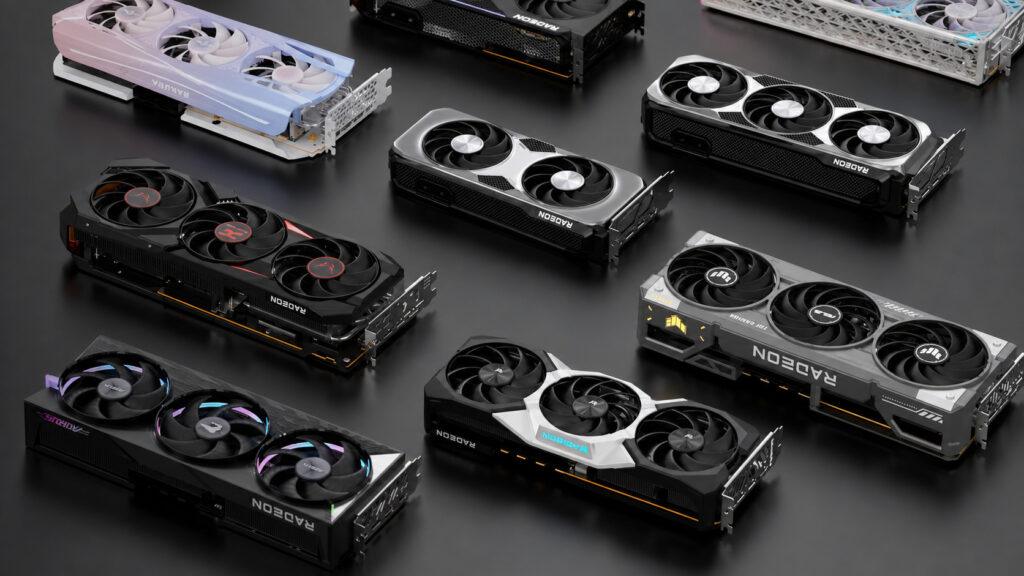
AMD Is Now the Pressure Valve, Not an Automatic Winner
Switching to Radeon is the obvious response, but brand switching should still be workload-driven. AMD launched the RX 9070 and RX 9070 XT with 16GB of GDDR6 and suggested prices of $549 and $599 respectively. The company’s RX 9000 Series specifications also position both cards around high-resolution gaming, improved ray tracing, and FSR 4.
Radeon pricing is not immune to the same component pressure. The August snapshot put the RX 9070 XT at a $799.99 median, about 5% higher than the previous survey. That is still a different trajectory from the 36% RTX 5070 jump, but it warns against assuming AMD prices will remain untouched.
For gamers focused mainly on 1440p or 4K performance, Radeon deserves a fresh comparison at checkout. For streamers, creators, or local-AI users tied to Nvidia-specific software features, switching may create workflow tradeoffs that erase part of the savings. AMD is now the pressure valve, not a universal answer.
Buying Now Makes Sense Only When the Price Solves a Real Problem
Fear of another increase is not a good buying strategy by itself. Buying now makes sense when the current GPU is failing, a new game or production workload cannot run acceptably, or a specific card appears at a price that restores reasonable performance per dollar.
Nvidia buyers should pay attention to individual models rather than series-wide averages. The RTX 5070 Ti median remained flat in the same survey while the RTX 5070 surged. A higher-tier card can therefore become the more rational purchase if the gap between two products narrows enough.
The same logic applies to complete builds. Instead of stretching hundreds of dollars for an inflated GPU, a gamer may get a better system by protecting enough budget for memory, storage, power delivery, and cooling.
Waiting Is Rational When Your Current GPU Still Meets the Target
Gamers with acceptable frame rates today have the strongest negotiating position: they can do nothing. Paying a steep scarcity premium because prices might rise again converts uncertainty into a guaranteed overpayment.
Set a maximum price before shopping and judge the card against your actual target resolution, refresh rate, ray-tracing preference, and workload. That keeps an RTX 5070 at $900 from being treated as the same decision as one near its original $549 starting point.
This is also the moment to challenge the assumption that every PC refresh needs a new GPU. A monitor, SSD, memory upgrade, cooling improvement, or another year with the current card may produce more value than chasing an inflated generation.
Supply, Memory Costs, and Radeon Pricing Are the Signals to Track
Three signals matter next: whether more RTX 50-Series inventory appears near launch pricing, whether AMD’s smaller increases accelerate, and whether memory-related component costs keep pushing complete PC builds higher.
Retail medians can move quickly when inventory composition changes, so one snapshot should not become a permanent price guide. Compare several reputable retailers, distinguish first-party inventory from marketplace sellers, and avoid treating one unusually cheap listing as the normal market price.
A temporary discount can change the answer overnight. That is why the best rule is buy for the workload and the price in front of you, not for the badge on the cooler.
RTX 50-Series GPU prices have turned what should be a straightforward generation choice into a value test. If Nvidia pricing stays elevated while Radeon remains comparatively stable, AMD gains leverage; if Blackwell stock returns closer to launch levels, the equation changes again. Gamers who can wait should preserve that flexibility, while buyers who need performance now should compare real street prices rather than assume any model still occupies its original tier.
FAQs
Should I buy an RTX 5070 at around $900?
For gaming alone, that price deserves serious comparison shopping. The card launched at $549, so a price near $900 substantially changes its value relative to Radeon alternatives and higher-tier GPUs.
Is AMD automatically better value than Nvidia now?
No. Radeon may offer stronger value at certain current prices, but software features, ray tracing, streaming tools, creator applications, and local-AI workloads can make Nvidia worth paying more for some users.
Could RTX 50-Series GPU prices fall again?
Yes. Retail pricing can change as supply, component costs, promotions, and inventory improve. Gamers without an urgent upgrade need are in the best position to wait for pricing closer to their target.