

The PlayStation Portal Remote Player is one of the most debated gaming devices in recent years. When Sony first revealed it, reactions were mixed. Some saw it as a clever extension of the PlayStation 5 ecosystem, while others dismissed it as an unnecessary accessory in a world already filled with handheld gaming devices.
After spending time analyzing its performance, design, and real-world usability, I’ve come to a more nuanced conclusion. The PlayStation Portal is neither a complete breakthrough nor a total misstep it sits somewhere in between, depending heavily on how and where you play.
What Exactly Is the PlayStation Portal?
At its core, the PlayStation Portal Remote Player is not a traditional handheld console. It doesn’t run games natively. Instead, it streams games directly from your PlayStation 5 over Wi-Fi using Sony’s Remote Play technology.
That distinction is critical. Unlike devices such as the Steam Deck or Nintendo Switch, the Portal relies entirely on your existing PS5 hardware. If your console is off or your internet connection is unstable, the experience quickly falls apart.
However, when everything is working properly, the concept starts to make sense. The Portal allows you to play your PS5 games anywhere in your home or even remotely, depending on your network setup without needing a TV.
Design and Build Quality
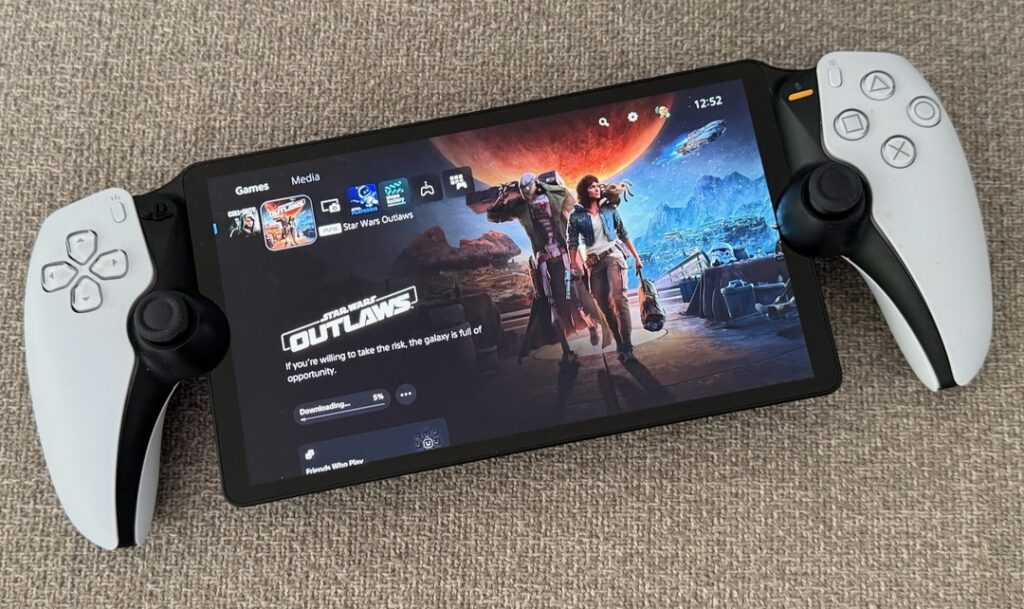
Sony clearly leaned into familiarity when designing the Portal. The device essentially looks like a DualSense controller split in half, with an 8-inch LCD screen placed in the center. From a usability standpoint, this is one of its strongest advantages. The controls feel identical to a PS5 controller, complete with adaptive triggers and haptic feedback. That alone gives it an edge over many third-party streaming devices.
The screen itself is sharp and vibrant, offering a 1080p resolution at 60Hz. While it doesn’t compete with OLED displays found in some competitors, it is more than adequate for most gaming scenarios.
Performance: Where It Shines—and Where It Struggles
Performance is where the PlayStation Portal becomes highly situational.
On a strong home Wi-Fi network, the experience can feel surprisingly seamless. Games load quickly, input lag is minimal, and visuals remain consistent. Titles like Spider-Man 2 or Call of Duty can feel nearly identical to playing on a TV.
However, the reliance on streaming introduces unavoidable limitations. If your connection dips, even slightly, you may encounter:
- Input delay
- Visual compression
- Occasional stuttering
These issues become more noticeable in fast-paced or competitive games, where timing is everything.
In my view, this is the defining trade-off. The Portal works best in controlled environments with stable internet. Outside of that, its performance becomes unpredictable.
Price and Availability
The PlayStation Portal Remote Player is priced at around $199 USD, making it relatively affordable compared to full-fledged handheld consoles.
You can find it at major retailers:
At this price point, Sony is positioning the Portal as an accessory rather than a standalone gaming device. That distinction helps justify the cost, but it also limits its audience.
Who Is It Really For?
Understanding who the Portal is designed for is key to evaluating its value.
This device is ideal for:
- Gamers who share a TV and need flexibility
- Players who want a more comfortable way to game in bed or on the couch
- PS5 owners deeply invested in Sony’s ecosystem
On the other hand, it may not appeal to:
- Gamers looking for true portability
- Players without a strong, reliable internet connection
- Those expecting a standalone handheld console experience
The Portal doesn’t try to replace your console it tries to extend it. Whether that matters depends entirely on your lifestyle.
Comparing It to the Competition
It’s impossible to review the Portal without comparing it to alternatives. Devices like the Steam Deck or ASUS ROG Ally offer native gameplay, meaning they don’t rely on streaming. That gives them a clear advantage in versatility.
However, the Portal counters with simplicity. There’s no setup complexity, no compatibility issues, and no need to repurchase games. Everything runs through your existing PS5 library.
In that sense, Sony has chosen convenience over flexibility.
The Controversy Explained
The reason the PlayStation Portal remains controversial is simple: expectations. Many gamers expected Sony to release a true handheld console. Instead, they received a streaming-focused device. That disconnect created skepticism from the start.
But when evaluated on its intended purpose not what people hoped it would be the Portal becomes easier to understand. It is not trying to compete with handheld PCs. It is trying to make PS5 gaming more accessible within your daily routine.
That distinction changes the conversation entirely.
Final Verdict: Genius or Gimmick?
After breaking down its features, performance, and real-world use cases, the answer isn’t as extreme as the headline suggests. The PlayStation Portal Remote Player is not a gimmick. It delivers exactly what it promises: a smooth, comfortable way to stream PS5 games on a dedicated handheld device.
At the same time, it’s not a revolutionary product either. Its usefulness is heavily dependent on your setup, your internet quality, and how you prefer to play.
RAVE-TECH Final Score: 7.5 / 10
Why this score:
- Strong design and comfort
- Seamless integration with PS5
- Affordable price point
- Limited by streaming dependency
Conclusion
The PlayStation Portal represents a very specific vision of gaming—one where convenience and ecosystem integration matter more than raw independence. For the right user, it can feel like a smart upgrade that adds flexibility to everyday gaming. For others, it may feel redundant in a market filled with more versatile devices.
In the end, the Portal is best understood not as a replacement for your console, but as a companion to it. And like any companion device, its value depends entirely on how often you’ll actually use it.