

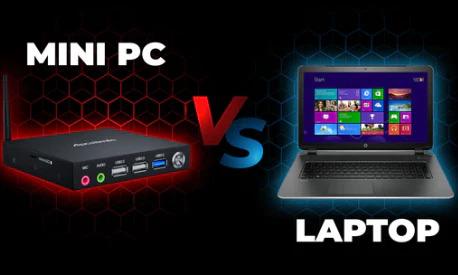
A gaming mini PC vs gaming laptop decision looks simple until the desk, display, cooling, and travel needs get involved. One promises compact desktop power without a tower; the other gives gamers a complete all-in-one machine with screen, keyboard, battery, and portability built in.
That is why this comparison should not be reduced to size. A mini PC may deliver cleaner desk power, easier monitor pairing, and better cable permanence, while a gaming laptop is still the stronger choice for anyone who actually needs to move the whole setup. Rave-Tech’s look at a compact mini PC performer shows why small machines are becoming more serious, but the buying decision still depends on how the system will be used every week.
Mini PCs Make Sense When The Desk Is Permanent
A gaming mini PC makes the most sense when the user already has a good monitor, desk, keyboard, mouse, and headset. In that setup, paying for a built-in laptop screen may feel wasteful.
Mini PCs also fit clean desk builds. They can reduce tower bulk, free floor space, and make a smaller room feel more organized. Some models now pack serious components into compact cases. ASUS, for example, lists its ROG NUC 2025 with Intel Core Ultra processors and NVIDIA GeForce RTX laptop GPUs in a compact vertical chassis.
The trade-off is that mini PCs depend on the rest of the setup. If the monitor is weak, the keyboard is cramped, or the speakers are poor, the mini PC cannot hide those gaps. A laptop may be less customizable, but it arrives as one complete package.
Gaming Mini PC vs Gaming Laptop Starts With The Setup
A gaming mini PC is not portable in the same way a gaming laptop is portable. It is small enough to sit behind a monitor, mount under a desk, or travel in a bag, but it still needs a display, keyboard, mouse, power, and usually speakers or a headset.
A gaming laptop is a complete system. It can sit on a desk, move to another room, travel to school, plug into a monitor, or run from battery for non-gaming tasks. That convenience is the laptop’s strongest advantage.
The mini PC fights back with desk permanence. Once it is wired to a monitor, Ethernet, audio gear, and peripherals, it can feel more like a compact desktop. Small does not always mean mobile, and that distinction matters before the purchase.
| Buying Factor | Gaming Mini PC | Gaming Laptop |
|---|---|---|
| Best use | Compact desk setup | Travel and all-in-one use |
| Display | External monitor required | Built-in screen included |
| Keyboard and mouse | Separate gear needed | Built in, but external gear helps |
| Cooling room | Depends on chassis | Depends on laptop design |
| Upgrade path | Model-dependent, often storage/RAM | Usually limited but convenient |
| Streaming fit | Strong with fixed desk gear | Better for mobile creators |
| Main risk | Hidden accessory cost | Heat, noise, and battery limits |
Gaming Laptops Still Win For Real Mobility
Gaming laptops remain the better answer for players who need performance in more than one place. A student, traveler, remote worker, or creator moving between rooms gets more from a laptop than from a mini PC plus accessories.
The best gaming laptops also carry stronger displays than many buyers expect. NVIDIA’s RTX laptop platform shows how modern gaming laptops combine high-end GPUs, AI rendering features, creator support, and slim designs. That makes laptops useful beyond gaming.
The catch is that gaming on battery is rarely the same as gaming on wall power. A laptop can be portable and powerful, but serious gaming still tends to favor a charger, airflow, and a stable surface. Portable power has conditions, especially when the GPU is working hard.
Thermals Can Decide The Experience
Heat is the quiet pressure point in this comparison. A mini PC has limited chassis volume, but it does not have to fit a display, hinge, keyboard, and battery. A gaming laptop has to fit everything into a thin body, which can mean higher fan noise and warmer surfaces under load.
That does not mean mini PCs automatically run cooler. A poorly designed mini PC can be loud, hot, or power-limited. A well-designed laptop can manage heat impressively. The buyer should look at cooling design, fan behavior, power limits, and how the machine performs after long sessions, not just peak benchmark claims.
Streaming adds more pressure. A laptop used for gaming, OBS, alerts, browser sources, and recording can get loud. A mini PC tied to a desk may pair more comfortably with an external capture setup, but only if its CPU, GPU, and ports match the workload.
Upgrade Limits Are Different, Not Always Better
Many buyers assume a mini PC is more upgradeable than a laptop. Sometimes that is true, especially for RAM and storage. But compact gaming systems often use laptop-class GPUs, tight internal layouts, and limited power supplies. The upgrade path may be narrower than the desktop look suggests.
Gaming laptops are also limited, but buyers know the bargain: screen, battery, keyboard, trackpad, speakers, webcam, and performance in one device. Storage and RAM upgrades vary by model, while GPU upgrades are generally not realistic.
The smart move is to check before buying. Look for accessible M.2 slots, RAM type, warranty impact, external GPU support, port layout, and cooling limits. Upgradeability should be verified, not assumed from the form factor.
The Hidden Cost Is The Gear Around It
A mini PC may look cheaper until the missing pieces appear: monitor, keyboard, mouse, webcam, speakers, headset, dock, USB hub, or Windows license depending on configuration. Those accessories can raise the real cost quickly.
A laptop includes more hardware upfront but may still need a cooling stand, external monitor, mouse, keyboard, headset, and dock for a proper gaming desk. The difference is that the laptop works immediately, while the mini PC becomes useful only when the surrounding setup is ready.
This is why buyers should price the full station, not just the computer. A mini PC is often the better desk brain. A laptop is often the better single purchase.
The Next Compact Gaming Choice Is About Use Case
Compact gaming hardware is moving fast, and the line between mini PCs and laptops will keep blurring. Mini PCs are getting stronger GPUs, faster ports, and cleaner desk appeal. Gaming laptops are getting thinner, more efficient, and more capable as creator machines.
The deciding factor should be behavior. If the system stays on one desk and pairs with a strong monitor, a gaming mini PC can be the cleaner long-term fit. If the system needs to travel, move around the house, or serve as a work machine, the laptop remains harder to beat.
Gaming mini PC vs gaming laptop matters because both can look compact on paper while serving different lives. Buy the mini PC when the desk is the destination. Buy the laptop when the whole setup needs to move with you.