
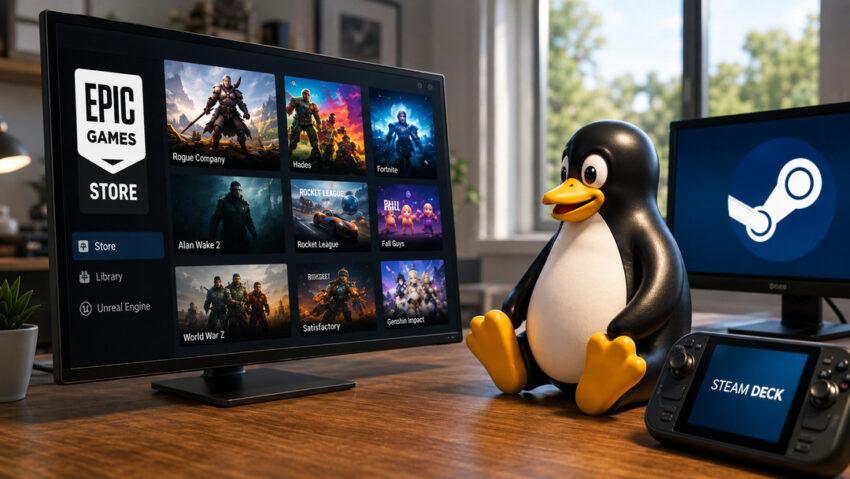
Epic Games Store Linux support is finally moving from workaround territory toward an official client. Epic has confirmed that a native Linux version of its launcher is in development, a change that could make the company’s library substantially easier to use on Linux PCs and potentially on Steam Deck.
The timing matters because portable PC gaming has made operating-system compatibility visible to far more players. Steam Deck already offers much of the flexibility covered in this Steam Deck comparison, but installing non-Steam storefronts remains one of the least console-like parts of the experience.
Epic Games Store Linux Support Removes a Storefront Barrier
The confirmation surfaced through an Epic Games Store community Discord AMA in August 2026. An Epic staff member said a native Linux version is coming “soon,” while making clear it will not be part of the next launcher preview because the work goes beyond simply producing a Linux build. The native Linux launcher confirmation makes clear that this is a larger engineering effort rather than a quick port.
That wording should keep expectations measured. Epic has not announced a firm release date or named the Linux distributions it plans to support. SteamOS is an obvious platform to watch, but it has not been formally confirmed.
Until the client ships, Linux users still need existing alternatives to reach Epic libraries. Community-developed launchers such as Heroic remain among the established options today. The announcement changes the direction of travel, not the current setup overnight.
Steam Deck Could Be the Biggest Practical Winner
Desktop Linux users stand to benefit, but Steam Deck is where the change could become most visible. Valve’s handheld uses Linux-based SteamOS, and its console-like experience works best when games can be installed, authenticated, updated, and launched without extra compatibility work.
Epic libraries are already accessible through community tools such as Heroic Games Launcher, Lutris, and manual installation methods. Those options are capable, but they add steps that Steam purchases generally avoid.
A native Epic client could provide an official login, store, library, update, and account-management path. The potential improvement is not higher frame rates. It is fewer reasons to enter Desktop Mode, manage compatibility environments, or explain why a PC game bought from one storefront needs a different setup process.
That matters commercially too. Convenience can shape the store choice when the same game is easier to install and maintain through one platform than another.
A Native Launcher Does Not Make Every Epic Game Linux-Compatible
The biggest misconception would be treating launcher support as game support. A native client can solve storefront and account problems without changing whether a Windows game itself works correctly under Linux.
Individual titles may still depend on Windows-specific components, DRM, middleware, secondary launchers, codecs, or anti-cheat systems. The practical distinction is straightforward:
| Layer | What Native Epic Support Could Improve | What It Cannot Guarantee |
|---|---|---|
| Store access | Direct Epic storefront on Linux | Every game becomes Linux-native |
| Library management | Easier installs and updates | Universal Proton compatibility |
| Authentication | Official account and launcher flow | Every game authenticates correctly |
| Steam Deck setup | Fewer storefront workarounds | Every title works in Gaming Mode |
| Multiplayer | Easier access to supported games | Anti-cheat support for every title |
This is why launcher support is only layer one. A Steam Deck owner could eventually install Epic’s client natively and still discover that a particular multiplayer game will not run.
Linux gaming has advanced partly because compatibility technologies can run many Windows titles without developers producing separate Linux builds. Compatibility, however, remains title-specific. An official storefront does not erase that technical reality.
Fortnite Exposes the Anti-Cheat Gap
Fortnite is the clearest test. Epic’s current support documentation says the game is not supported through non-native operating-system environments on Linux devices. A Linux Epic Games Store client therefore should not be mistaken for a Fortnite-on-Steam-Deck announcement.
The situation is more nuanced because Epic’s Easy Anti-Cheat technology already supports Linux as well as Wine and Proton compatibility layers. Epic says developers can activate Linux anti-cheat support through its online-services tools, meaning the underlying middleware can accommodate Linux.
Implementation still depends on individual games and developers. Epic supporting Linux in its storefront does not automatically change Fortnite’s policy, nor does it force every Easy Anti-Cheat title to enable Proton compatibility.
That makes anti-cheat the harder problem. For compatible single-player and multiplayer games, the launcher could eliminate real inconvenience. For blocked competitive titles, the storefront may arrive before the games do.
Heroic Will Not Become Useless Overnight
An official launcher also does not guarantee that community tools immediately lose their purpose. Heroic has become an established way for Linux users to interact with Epic libraries while managing compatibility tools around Windows games.
Epic’s native client could be simpler for players who want the official path. Power users may continue preferring third-party tools if they provide greater control over compatibility versions, prefixes, launch arguments, or library integration.
The comparison depends on what Epic actually ships. A native launcher that integrates poorly with SteamOS Gaming Mode or offers weak compatibility controls could leave plenty of room for alternatives.
A polished client could produce the opposite result. If installation, authentication, updating, and launching become straightforward, official support becomes the easiest option for users who never wanted Linux gaming to become a troubleshooting project.
Release Details Will Decide Whether This Changes Linux Gaming
The next signals matter more than the word “soon.” Epic still needs to clarify supported distributions, SteamOS behavior, controller navigation, installation requirements, Gaming Mode integration, update handling, and how Windows-only titles will appear inside the Linux client. Epic has not yet published those details.
Compatibility messaging will be equally important. A storefront that clearly identifies playable and unsupported titles could reduce confusion. One that displays an entire Windows library without explaining what actually runs would simply move the troubleshooting deeper into the experience.
Fortnite remains a major pressure point. If Epic eventually changes its position, native store support becomes far more consequential for mainstream Steam Deck users. If it does not, Fortnite will keep illustrating the difference between supporting Linux as a storefront and supporting Linux as a complete gaming platform.
Epic Games Store Linux support is still an announced project rather than a finished product, so expectations should stay measured. Even so, an official client could remove one of the most persistent inconveniences of using a non-Steam library on Linux.
The bigger breakthrough will come only if game compatibility follows. Epic can make reaching its store easier; developers, middleware choices, and anti-cheat policies will determine how much of that store Linux gamers can actually play.
Frequently asked questions
When will the Epic Games Store launch on Linux?
Epic has not announced a specific release date. A company staff member said the Linux version is coming “soon,” but also confirmed it will not be included in the next launcher preview.
Will Epic Games Store Linux work on Steam Deck?
SteamOS support has not yet been formally detailed. Because Steam Deck runs a Linux-based operating system, it is an obvious potential use case, but gamers should wait for Epic’s compatibility announcement.
Will Fortnite work on Steam Deck once the Linux launcher arrives?
Not automatically. Fortnite currently does not support the relevant Linux compatibility environment. A native Epic launcher and Fortnite compatibility are separate issues, so Epic would need to change the game’s support policy.
Will Steam Deck users still need Heroic Games Launcher?
Possibly. An official Epic client could make basic installation and account management easier, but Heroic may remain useful for players who want more control over compatibility tools, prefixes, and launch settings.
Does a native Epic Games Store client mean all Epic games will work on Linux?
No. The launcher can provide official store access, but individual games may still depend on Windows-specific software, anti-cheat systems, DRM, or other components that prevent them from running properly on Linux.