
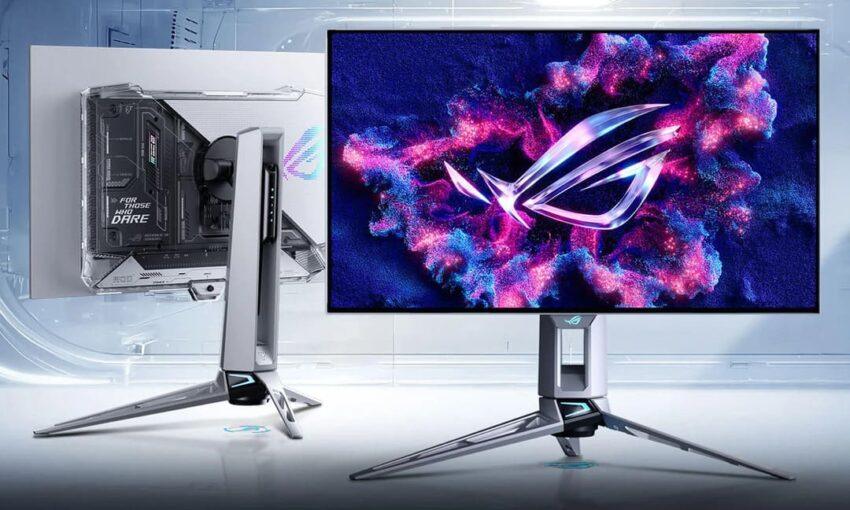
The 720Hz OLED gaming monitor era is about to get its first serious esports test. ASUS has confirmed that the ROG Swift OLED PG259QWS Ace will be used at the PGL CS2 Major Singapore 2026, making it the first Counter-Strike Major played on OLED displays.
Professional Counter-Strike has long favored smaller, ultra-fast monitors where motion clarity and consistency matter more than cinematic image quality. Singapore will put a 24.5-inch, 1080p Tandem WOLED panel with a 720Hz refresh rate and claimed 0.02ms response time directly into that environment, turning an impressive specification into a real competitive trial.
The same principle applies across an esports streaming setup: the display, PC, network and capture chain all have to work together. One premium component cannot erase a bottleneck elsewhere.
The broader question is no longer whether manufacturers can build faster displays. It is whether players can feel enough of the difference to make the upgrade meaningful.
The 720Hz OLED Gaming Monitor Is Built for One Job
The PG259QWS Ace is not trying to be a giant 4K showcase display. The official monitor announcement lists a 24.5-inch 1920 x 1080 panel, 720Hz refresh rate, TrueBlack Glossy Tandem WOLED construction, 99.5% DCI-P3 coverage and a claimed 0.02ms response time.
Those choices tell you exactly who it is for. Counter-Strike players prioritize high frame rates, rapid target acquisition and predictable motion. Keeping the panel at 1080p also reduces the rendering burden compared with 1440p or 4K when a system must feed hundreds of frames per second.
ASUS added competition-focused tools as well. A position sensor is designed to help players reproduce monitor placement, while three esports color modes and a quick on-screen display simplify setup changes. Repeatability matters at LANs because players constantly move between practice rooms, stages and tournament PCs.
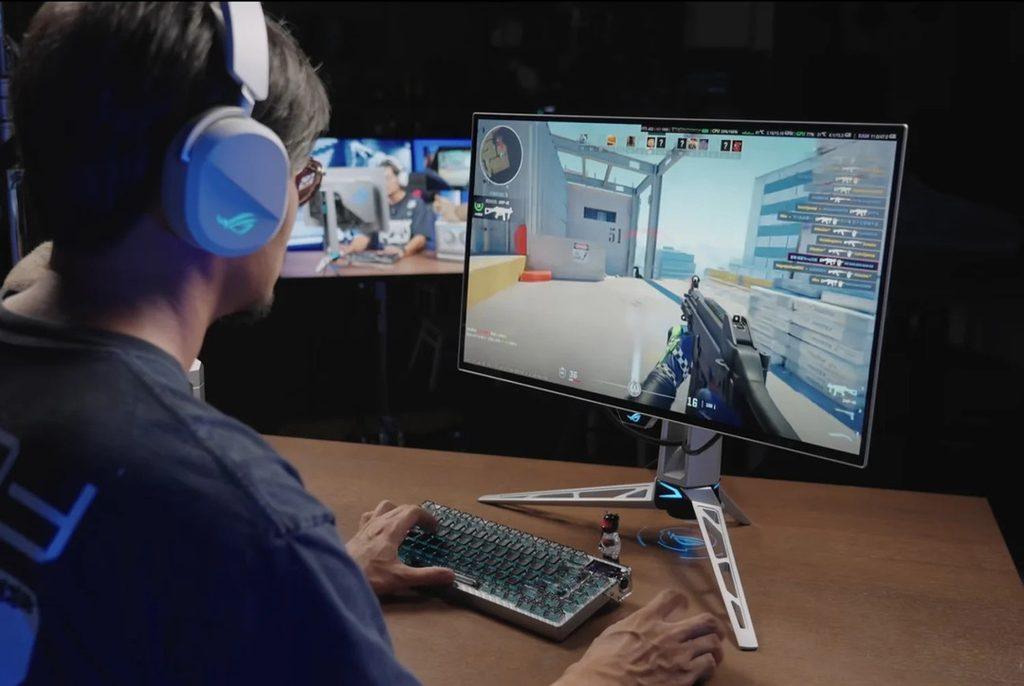
OLED Is the Bigger Change Than 720Hz
The refresh-rate number will dominate headlines, but the panel transition may be more important.
Fast TN screens became entrenched in competitive shooters because they delivered high refresh rates and strong motion performance long before OLED could match them. A familiar example is the 24.5-inch ZOWIE XL2566K, a 1080p Fast TN monitor running at 360Hz. Singapore effectively doubles that refresh-rate figure while moving to self-emissive OLED pixels.
That does not automatically make TN obsolete. TN displays remain proven and familiar, while elite players can be unusually sensitive to changes in color, brightness and motion presentation. Faster on paper is not enough if players do not trust what they see.
Here is the practical comparison.
| Display Factor | Traditional 360Hz Fast TN | ROG PG259QWS Ace |
|---|---|---|
| Panel type | TN | Tandem WOLED |
| Resolution | Commonly 1920 x 1080 | 1920 x 1080 |
| Refresh rate | 360Hz | 720Hz |
| Pixel response | Fast LCD response | Claimed 0.02ms |
| Competitive strength | Proven motion clarity | Higher refresh plus OLED response |
| Main question | Is established performance enough? | Is the gain meaningful in matches? |
The table shows why Singapore matters. This is not simply an image-quality upgrade. It challenges a display formula competitive FPS players have trusted for years.
720Hz Still Needs a PC That Can Feed It
A 720Hz panel can refresh the image 720 times per second, but that does not mean the player automatically sees 720 unique game frames every second. The PC still has to render them.
CS2 is a logical proving ground because competitive players already use low settings and powerful CPUs to chase extremely high frame rates. Sustaining performance near 720fps through utility, firefights and busy rounds, however, is much harder than posting a peak number in a quiet scene.
This is where consumer expectations need restraint. The monitor cannot create frames. A player moving from 240Hz or 360Hz to 720Hz without a system capable of extremely high and stable frame rates will not exploit the headline specification like a tournament-grade machine might.
Singapore Gives OLED the Test Marketing Cannot
Tournament adoption is more revealing than product positioning. ASUS says the PG259QWS Ace was developed with feedback from PGL and professional players, including details aimed specifically at reproducing display positioning and settings in competitive environments.
Players will practice on these screens, adjust them under pressure and use them during matches where missed visual information has consequences. If competitors accept the transition without demanding a return to familiar TN hardware, that will matter far more than a laboratory specification.
Singapore also has enough competitive weight to make the trial meaningful. The Major tournament structure brings 32 teams together for a $1.25 million prize pool, with the playoffs scheduled for Singapore Indoor Stadium.
The Real Battle Is 360Hz Versus Diminishing Returns
Going from 60Hz to 144Hz is easy for many players to notice. Higher jumps become more nuanced because each additional refresh cuts an already small frame interval.
At 360Hz, one refresh takes about 2.78 milliseconds. At 720Hz, that falls to about 1.39 milliseconds. That is measurable, but it does not mean every gamer will perceive or benefit from it equally.
For professional Counter-Strike, tiny margins can still matter. For everyone else, cost, GPU and CPU performance, resolution and actual skill level may matter more than chasing the largest refresh-rate number. Diminishing returns are real, even when the hardware improvement is legitimate.
Singapore Will Decide What Comes After the Spec War
The signals to watch are player feedback, whether competitors keep using OLED after the event, whether other tournament organizers follow PGL, and whether 720Hz panels spread beyond a small group of flagship products.
If the Major runs smoothly and pros embrace the displays, monitor makers will have a strong argument that OLED is ready to replace TN at the highest level of FPS competition. If players remain divided, the market may find that familiarity and motion tuning matter as much as raw speed.
The first Counter-Strike OLED Major therefore gives the 720Hz OLED gaming monitor something no launch presentation can provide: consequences. Singapore will show whether 720Hz OLED is merely the newest number in the esports hardware race or the point where professional gaming monitors genuinely change direction.