

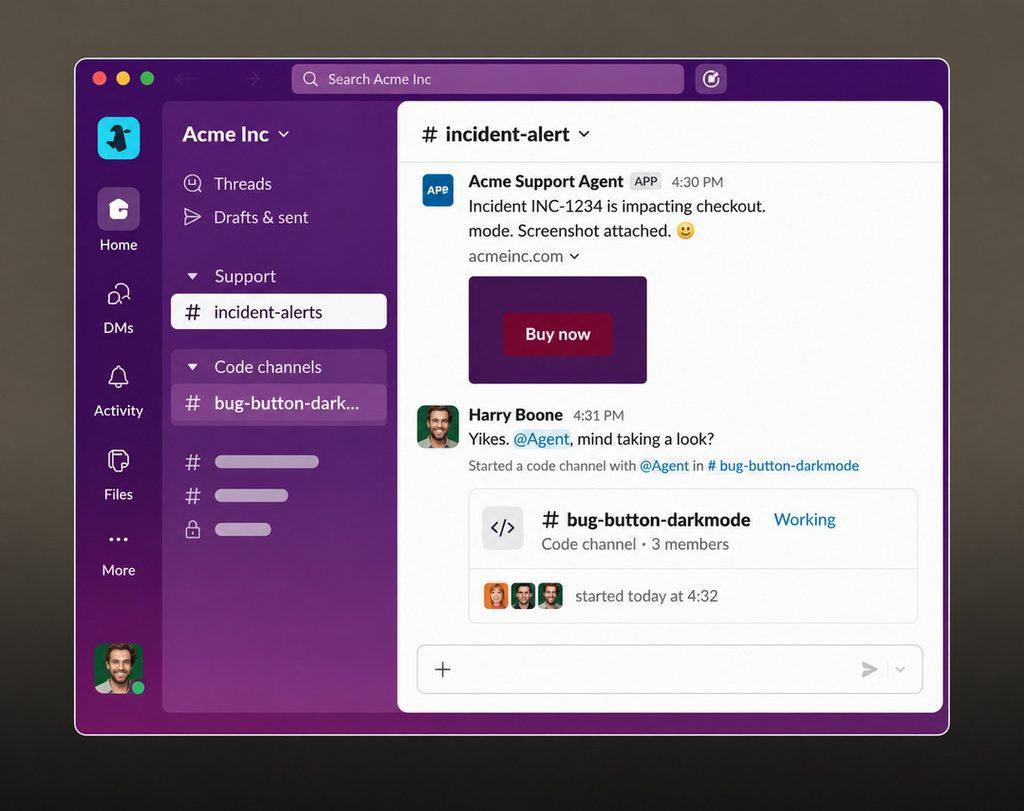
Slack Code AI agents are pushing AI-assisted programming out of the private terminal and into the place where teams already argue about bugs, priorities and releases: the group chat. Slack’s new code channels do not simply add another chatbot; they turn the channel into a shared control surface for software work.
That matters because the bottleneck in agentic coding is increasingly not code generation. It is coordination. The same pattern is visible in stream workflow automation, where an interface that once displayed work is being asked to trigger and manage it. Slack is applying that idea to development, with shared context becoming part of the programming environment.
AI Coding Is Becoming a Team Activity
AI coding tools initially gained traction as highly personal productivity systems. A developer could ask an assistant to explain unfamiliar code, generate a function, repair an error or suggest a refactor without leaving the editor. That model made AI useful, but it also kept much of the interaction inside an individual workflow.
Agentic coding has pushed beyond those early boundaries. Newer systems can take broader instructions, modify multiple files, run tests and continue working through a task with less step-by-step direction. As their autonomy increases, however, the surrounding workflow becomes more important because teams need to understand what the agent was asked to do and how it arrived at a proposed change.
That creates a coordination problem. Product managers, designers and engineers often discuss requirements in one platform, track issues in another and review code somewhere else. When an AI agent works in a separate terminal or development environment, important context can become fragmented before a change ever reaches review.
Slack Code approaches the problem by treating conversation as part of development infrastructure. Instead of forcing every request through a single developer’s private AI session, it creates a shared environment where the people defining the work can remain connected to the agent that is carrying it out.
Slack Code AI Agents Move the Work Into the Channel
Slack Code, announced on August 20, 2026, creates project-specific code channels when a user tags a supported coding agent. The launch lineup includes Anthropic’s Claude, Cognition’s Devin, GitHub Copilot, ChatGPT and Vercel agents. Slack Code is available across Slack plans, although users still need access to the partner agents they want to use.
Inside a code channel, teammates can follow the conversation, inspect the agent’s plan, compare code diffs and view live HTML previews. Finished channels can archive automatically while preserving a record of the work. The Slack Code feature details also describe controls that let people redirect or stop an agent and require expert sign-off for high-stakes actions such as pushing code toward production.
The agent is no longer hidden behind one developer’s terminal session. Its instructions, output and revisions become visible to the people supplying the business context.
The Real Shift Is From Copilot to Multiplayer
Early AI coding products centered on an individual developer. Autocomplete suggested lines, chat tools answered questions, and later agents began editing files, running tests and preparing pull requests.
Slack Code changes the unit of interaction from one person and one agent to a team and an agent. A product manager can surface a bug, a designer can inspect a preview, an engineer can review the diff, and the agent can keep working inside the same project space.
Anthropic had already been moving in this direction with Claude Tag. When it introduced the Slack-based beta in June, the company said its internal version was generating 65% of its product team’s code. Its Claude Tag team workflow follows a similar premise: an agent becomes more useful when it can carry selected team context into the task.
The result is less “vibe coding in public” than multiplayer orchestration. People supply constraints, review outputs and decide whether the work should advance.
A simple comparison shows where the workflow is changing.
| Development step | Single-user AI coding | Slack Code model |
|---|---|---|
| Task context | Developer prompt and local session | Shared project conversation |
| Agent interaction | Usually one user | Multiple teammates |
| Review | IDE, pull request or separate tool | Diffs and previews in channel |
| Feedback | Returned to developer | Added directly by the team |
| Approval | Tool-specific handoff | Human sign-off in the workflow |
| Project record | Often fragmented | Archived channel and audit history |
The important difference is not that Slack writes code better. It is that more of the decision trail can sit beside the generated work.
Slack Is Not Replacing the IDE Yet
Calling Slack the new IDE would be premature. Professional development still depends on repositories, branches, build systems, tests, debuggers, deployment pipelines and specialized editors. Slack Code sits above much of that machinery rather than replacing it.
Its more realistic role is the collaboration layer that coordinates those systems. That may prove more consequential than competing directly with Visual Studio Code, Cursor or a terminal-based agent.
For routine changes, where a task begins could matter more than where code is edited. A bug discussed in Slack can become an agent task without someone translating the conversation into a ticket and rewriting its context for an assistant.
That compression of handoffs is the product opportunity.
Shared Visibility Could Fix One of Vibe Coding’s Weak Spots
Vibe coding is fast partly because users can operate at a higher level of abstraction. The danger is that generated changes can outrun understanding. A private agent session makes that worse because teammates may see the result only after substantial work is complete.
Putting diffs, previews and discussion in a shared channel does not make AI-generated code correct. It does move review closer to generation.
Slack Code democratizes initiation more than accountability. A non-engineer may be able to start a task or shape a prototype, but production software still needs technical judgment around architecture, security, testing and failure modes.
The strongest version of this workflow keeps human approval as a gate, not ceremonial confirmation after the agent has effectively made the decision.
The Pressure Points Are Permissions, Review and Context
The next test is whether shared agents remain manageable at scale. An agent that can see useful context also raises questions about which channels, repositories and services it should access. More context can improve output, but excessive context can expose irrelevant or sensitive information.
Review quality is another pressure point. A visible diff helps only if someone qualified examines it. Teams could otherwise replace “AI wrote code in a private tab” with “AI wrote code in a busy channel that everyone assumed someone else reviewed.”
If every bug and prototype creates a new agent-driven channel, collaboration software could become noisy in a different way. Automatic archiving helps, but teams still need conventions for ownership and production approval.
Those governance details will determine whether code channels become infrastructure or novelty.
Slack Code Is Testing a New Control Surface for Software
Slack Code AI agents matter because they relocate the center of AI development from the individual coding session toward the shared decision space. The IDE remains essential, but it may no longer be where every software task starts, gets reviewed or receives approval.
If this model works, collaboration platforms will do more than discuss software. They will become the new control surface where people assign work to agents, inspect what changed and decide what ships. That is a much bigger shift than adding coding features to chat.
Frequently asked questions
What is Slack Code?
Slack Code is a Slack workflow built around project-specific code channels where supported AI coding agents can work alongside teams. Participants can inspect plans, review code changes, view previews, provide feedback and approve sensitive actions.
Does Slack Code replace a traditional IDE?
No. Slack Code currently functions more as a collaboration and orchestration layer. Developers still rely on editors, repositories, testing systems and deployment infrastructure while Slack centralizes context, agent activity and team review.
Which AI agents work with Slack Code?
Slack Code supports integrations with AI coding agents from companies including Anthropic, Cognition, GitHub, OpenAI and Vercel. Users still need appropriate access to the individual agent services they want to use.
How could Slack Code change software development workflows?
Slack Code can reduce handoffs between discussion and implementation. Teams can move from identifying a bug or feature request to assigning an AI agent, reviewing its work and providing feedback within the same shared channel.
What are the main risks of using AI coding agents in Slack?
The biggest concerns involve permissions, sensitive context, weak code review and unclear ownership. Teams still need strong access controls and qualified human review before AI-generated changes are allowed into production systems.