

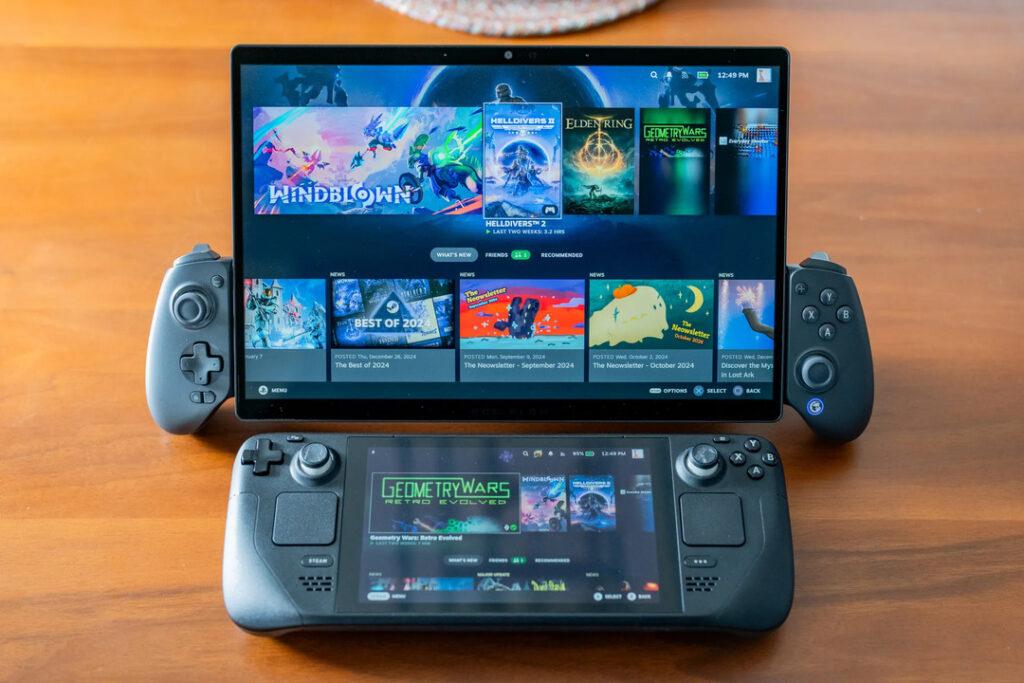
A gaming tablet vs handheld gaming PC choice is really a question about what “portable gaming” means to the buyer. A tablet is a brilliant screen for media, cloud gaming, touch games, and controller play; a handheld gaming PC is built to run PC games locally with controls attached.
That difference matters because both devices can look like portable gaming screens, but they serve different libraries and habits. A gaming tablet may be the better entertainment device, while a handheld PC may be the better game machine. Rave-Tech’s coverage of the ROG Flow Z13 shows how powerful gaming tablets can be, but most tablet buyers still need to ask what kind of games they actually plan to play.
Gaming Tablet vs Handheld Gaming PC Starts With The Library
The library is the first dividing line. A gaming tablet relies on mobile games, cloud gaming, remote play, app stores, and controller-supported titles. A handheld gaming PC usually runs PC game stores directly, including Steam, Xbox PC, Epic, and other launchers depending on the operating system.
That makes the handheld PC more direct for players who already own a PC library. Steam Deck OLED, for example, is built around Steam access, and Valve’s handheld technical specs list a 7.4-inch HDR OLED display, up to 90Hz refresh rate, and Wi-Fi 6E on the OLED model.
A tablet may still be the better screen, but the handheld PC often has the better native gaming path. The library decides the device before the processor does.
| Buying Factor | Gaming Tablet | Handheld Gaming PC |
|---|---|---|
| Best library fit | Mobile, cloud, remote play | Native PC games |
| Controls | Usually add-on controller | Built-in controls |
| Screen size | Often larger | Smaller but game-focused |
| Battery behavior | Strong for media | Varies heavily by game |
| Productivity | Usually better | Limited without dock |
| Game setup | Easier for casual play | More PC-like |
| Best buyer | Media and cloud gamer | PC library owner |
Tablets Win As All-Around Screens
A tablet is more than a gaming device. It can stream video, browse, draw, take notes, edit photos, handle calls, run apps, and serve as a second screen. That versatility matters for buyers who do not want a device that only plays games.
Apple’s iPad Pro details show why premium tablets remain attractive: strong chips, high-end displays, stylus support, keyboard accessories, and thin bodies. A gaming handheld PC may run more PC games, but it usually cannot match that same general-purpose tablet experience.
Tablets also work well for cloud gaming if the network is strong. Pair a controller, open a supported service, and the tablet becomes a larger portable display. For casual players, that may be enough.
Handheld PCs Win On Native Gaming
A handheld gaming PC is built for players who want local games, built-in controls, and fewer accessories. The appeal is simple: hold the device, launch a game, and play without balancing a tablet and controller mount.
ASUS lists the ROG Xbox Ally X with a 7-inch FHD 120Hz display, AMD Ryzen AI Z2 Extreme processor, Windows 11, and built-in Xbox integration. That kind of device is clearly aimed at PC-style games in a handheld format.
The trade-off is battery and settings. Demanding PC games may require lower resolution, reduced graphics, frame caps, or performance modes. A handheld PC can feel magical when tuned well and frustrating when treated like a full gaming desktop.
Controllers Change The Tablet Experience
A tablet needs a controller for serious gaming. Touch controls are fine for mobile games designed around them, but shooters, racing games, action titles, and cloud games usually feel better with physical controls.
That adds cost and complexity. The buyer may need a Bluetooth controller, phone-style telescopic controller, stand, case, or mount. The setup can be excellent, but it is not always as clean as a handheld PC with controls already attached.
The tablet can also feel awkward in public or in bed if the controller and stand setup is unstable. A handheld PC is more integrated. It may be heavier, but the controls, screen, and grips are one unit.
Integrated controls reduce friction, especially for quick sessions.
Cloud Gaming Makes Tablets More Competitive
Cloud gaming narrows the gap because the tablet does not need to run the game locally. It only needs a strong display, controller support, and a stable connection. Xbox’s ecosystem includes cloud gaming across multiple device types through supported browsers and apps, visible in its cloud gaming access path.
That makes tablets attractive for players who mainly use Game Pass-style libraries, remote play from a console, or cloud gaming services. The tablet becomes a high-quality screen instead of a local gaming machine.
But cloud gaming depends on network performance. Latency, Wi-Fi quality, data limits, and server distance all matter. A handheld PC can play many games offline or locally, which is still a major advantage for travel.
Battery Life Depends On The Kind Of Play
Tablets usually have excellent battery life for video, browsing, and light games. Cloud gaming can use more power, but it still offloads the hardest rendering work to remote servers.
Handheld gaming PCs use more power when running games locally. Battery life can vary dramatically between indie games and demanding AAA titles. That does not make them worse; it makes expectations important.
A buyer who wants all-day media and occasional cloud gaming may prefer a tablet. A buyer who wants local PC games on a plane, couch, or hotel bed may accept shorter battery life for better library access.
The Next Portable Screen Choice Is About Identity
The pressure point in this category is identity. Tablets are becoming more powerful and more gaming-capable. Handheld PCs are becoming more polished and more console-like. The overlap will keep growing, but the core use cases are still different.
A tablet should be bought as a screen-first device that can game well. A handheld PC should be bought as a gaming-first device that can do some computer tasks when docked or configured.
Gaming tablet vs handheld gaming PC matters because both can be expensive, portable, and impressive, yet one may sit unused if it does not match the buyer’s library. Choose the tablet if media, cloud gaming, and app flexibility matter most. Choose the handheld PC if native PC games and built-in controls are the reason you are buying.