

The top 10 AI gadgets in 2026 are not the flashiest devices with the loudest marketing. The best ones are the products that make work faster, calls cleaner, homes easier to manage, travel less stressful, and health tracking more useful without forcing buyers to become tech support for their own gear.
That is the real buying test this year. AI is moving from apps into laptops, glasses, earbuds, cameras, home hubs, and wearables, but not every “AI-powered” product deserves a place in your cart. Rave-Tech has already raised that question with AI earbuds upgrades, and the same discipline applies across the whole gadget market: useful AI should solve a daily problem, not just decorate a product page.
Top 10 AI Gadgets In 2026 Should Be Ranked By Usefulness
AI gadgets now cover almost every part of personal tech. Some help users write, search, summarize, and edit. Others improve translation, audio cleanup, home security, photo organization, fitness insights, and voice control.
The challenge is that many products promise intelligence without making life meaningfully easier. A good AI gadget should reduce friction. A bad one adds another app, another subscription, another privacy concern, and another device that needs charging.
That is why this ranking is built around practical value, not novelty. The best AI gadget earns its place when it saves time, improves accuracy, removes a repetitive task, or makes existing hardware more useful.
| Rank | AI Gadget | Best Use Case |
|---|---|---|
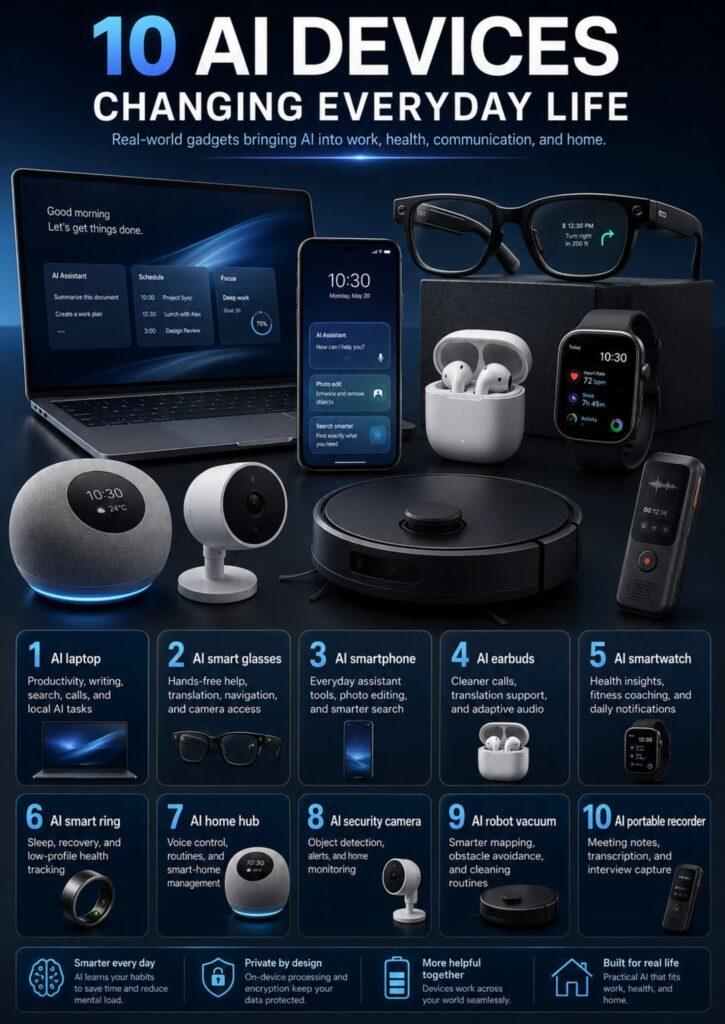
| 1 | AI laptop | Productivity, writing, search, calls, and local AI tasks |
| 2 | AI smart glasses | Hands-free help, translation, navigation, and camera access |
| 3 | AI smartphone | Everyday assistant tools, photo editing, and smarter search |
| 4 | AI earbuds | Cleaner calls, translation support, and adaptive audio |
| 5 | AI smartwatch | Health insights, fitness coaching, and daily notifications |
| 6 | AI smart ring | Sleep, recovery, and low-profile health tracking |
| 7 | AI home hub | Voice control, routines, and smart-home management |
| 8 | AI security camera | Object detection, alerts, and home monitoring |
| 9 | AI robot vacuum | Smarter mapping, obstacle avoidance, and cleaning routines |
| 10 | AI portable recorder | Meeting notes, transcription, and interview capture |
AI Laptops Are The Most Practical Upgrade For Work
AI laptops deserve the top spot because they are closest to the work many people already do. Writing, video calls, file search, photo cleanup, live captions, and assistant-style productivity all fit naturally on a computer.
Microsoft’s Copilot+ PC category shows where the market is heading: dedicated neural processing hardware, local AI features, and deeper AI tools inside the operating system. That does not mean every buyer needs the newest AI laptop immediately, but it does mean laptop shopping now has a new filter.
The key question is not whether the laptop has AI branding. It is whether the machine has enough memory, battery life, display quality, and software support to stay useful after the first wave of AI features changes.
Smart Glasses Are The Most Interesting Risk
AI smart glasses are the most exciting category because they move assistance away from the phone screen. Directions, texts, photos, translation, and quick answers become more natural when the device is already on your face.
Google’s 2026 Android XR update points directly at that future, with intelligent eyewear tied to Gemini, navigation, messaging, photos, and partnerships with eyewear brands. That makes smart glasses more serious than a novelty category.
Still, they carry real buyer risk. Comfort, battery life, prescription support, privacy, camera etiquette, durability, and style all matter more here than they do with a laptop. A great demo is not the same as all-day wearability.
AI Earbuds And Wearables Win By Being Quietly Useful
AI earbuds, smartwatches, and smart rings may not feel as futuristic as glasses, but they can deliver value more consistently. Earbuds can improve voice calls, adapt sound to the environment, support translation features, and make voice assistants easier to use while walking or commuting.
Smartwatches remain stronger for active users because the wrist is still the best place for quick alerts, workout data, heart-rate tracking, and habit prompts. AI can help turn raw health data into clearer patterns, especially when sleep, activity, stress, and recovery signals are combined.
Smart rings are more specialized. They are better for people who want sleep and recovery tracking without wearing a screen. They are not the right pick for everyone, but they can be more comfortable overnight than a watch.
Smart Home AI Works Best When It Stays Invisible
AI home hubs, security cameras, and robot vacuums are the least glamorous gadgets on the list, but they may be the easiest to justify. They work in the background and solve problems people already understand: lights, locks, cameras, cleaning, alerts, reminders, and routines.
An AI home hub becomes useful when it understands commands better, manages routines more naturally, and reduces the need to jump between apps. An AI security camera becomes useful when it can distinguish between people, pets, packages, cars, and random movement. A robot vacuum becomes useful when it avoids cords, maps rooms correctly, and cleans on a schedule without constant rescue.
These products also reveal the hidden trade-off in AI gadgets. More intelligence often means more data. Buyers should check privacy settings, cloud storage rules, account requirements, and subscription features before treating any smart-home device as a simple appliance.
The AI Gadgets Buyers Should Be Careful With
The weakest AI gadgets are the ones built around vague assistant promises. A small device that records, summarizes, or answers questions may sound appealing, but it has to beat the phone and laptop tools people already own.
Portable AI recorders can be useful for meetings, interviews, lectures, and field notes. But they need accurate transcription, reliable battery life, clean audio capture, strong privacy controls, and export options. Without those basics, they become expensive shortcuts to a task your phone may already handle.
The same caution applies to AI accessories with unclear value. If the product cannot explain what it does better than your existing phone, laptop, earbuds, or smartwatch, the buyer should slow down.
The Next AI Gadget Battle Will Be Trust
The next buying pressure is trust. AI gadgets are moving into personal spaces: faces, ears, wrists, bedrooms, living rooms, cars, and home security systems. That makes privacy, data control, software updates, and subscription costs part of the purchase decision.
Buyers should also watch interoperability. A gadget that works well only inside one ecosystem may be fine for loyal users, but frustrating for mixed-device households. Battery replacement, update support, repair options, and app quality also matter because AI features can age quickly if the software stalls.
The top 10 AI gadgets in 2026 show that the category is becoming less about futuristic promises and more about daily usefulness. The safest purchases are the devices that improve something you already do: work, communicate, sleep, travel, clean, create, or protect your home. AI is worth paying for when it removes effort. It is not worth paying for when it only adds a new label to old hardware.
FAQ’s
What is the best AI gadget to buy in 2026?
An AI laptop is the best first upgrade for most buyers because it supports work, calls, writing, search, and creative tasks. Smart glasses and wearables are more exciting but more dependent on comfort and habits.
Are AI gadgets worth buying now?
AI gadgets are worth buying when they solve a clear daily problem. They are less convincing when the main appeal is novelty, vague assistant features, or promises that depend heavily on future software updates.
Which AI gadget should budget buyers choose first?
Budget buyers should start with the device they already use most. For work, choose an AI-ready laptop. For calls and commuting, consider AI earbuds. For health tracking, a smartwatch or smart ring makes more sense.